What could one purchase with boxes of Crisco, bags of coffee and cartons of cigarettes in chaotic postwar Germany?
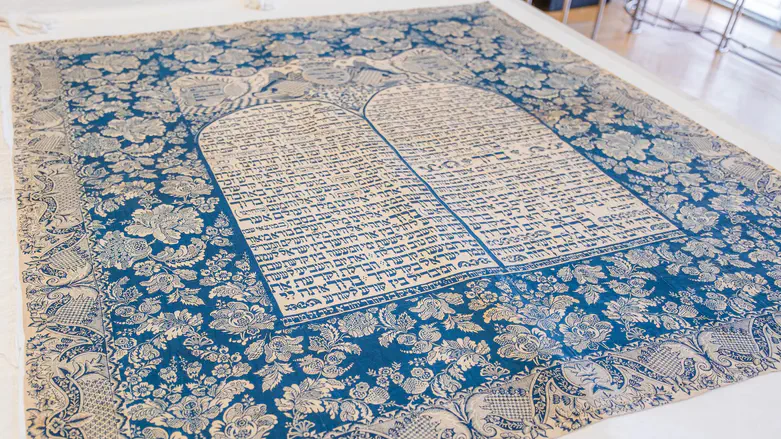
For Moishe Saksenhaus, a young Holocaust survivor from Belarus, the answer was: two Jewish ritual textiles, hundreds of years old.
The seller said he’d stolen them himself from a burning Berlin synagogue on Nov. 9, 1938 – the November Pogrom, commonly called Kristallnacht.
Moishe brought those two items – a Torah wimple, or sash, and a parochet, or Torah ark curtain – with him to America, taking them out of their suitcase only on special occasions. After Moishe’s death in 1993, his family donated them to his synagogue, Temple Chai in Phoenix, Arizona. They remained on display there until the building was deconsecrated in 2026. The congregation moved to a new location in nearby Scottsdale this spring.
Last week, nearly 88 years after Kristallnacht the two items made their way back to Berlin.
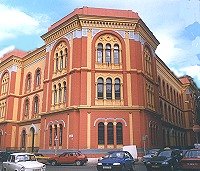
In a ceremony at the site of the New Synagogue Berlin Foundation-Centrum Judaicum museum and archive, on Oranienburger Strasse, Associate Rabbi Bonnie Koppell of Temple Chai handed them over to Berlin Jewish Community president Gideon Joffe.
„There were people who felt individually attached to the items” in Phoenix, Koppell told the Jewish Telegraphic Agency in a phone interview before her trip. „But ultimately, I think everyone realized that they belonged in their home. If the people from whom they were stolen wanted them back, that was where they belong.”
The handover took place Oct. 22 in the presence of Joffe, Rabbi Gesa Ederberg, historian Rabbi Andreas Nachama, members of the Berlin community and 29 visitors from Arizona.
„It’s been a very moving and touching journey, for both our guests from the United States and for these historical items,” said Nickolai Todorov, a Berlin Jew who accompanied the US visitors as a tour guide. „It was just a special thing to be an eyewitness to.”
The large parochet is embroidered with the text of the Kiddush, the Jewish blessing over wine, in versions for the Sabbath and holidays. Along the lower edge of the text is what might be the signature of the artist, in Hebrew: „This handiwork of mine is not to bring me honor, rather to bring merit for the multitudes in accord [with the biblical verse] ‘And Yitzchak went out to pray at the field’ – Yitzchak Itzik ben C’harad Yehuda Leib z“l [of blessed memory] from Rivnitz,” a town in Moldova whose small Jewish community dated back to at least 1800.
The highly decorated wimple, which would have been used to bind a Torah scroll, bears a blessing for a child named Yitzchak „Itzik” ben Kavod Ha-rav Gistori, likely embroidered in honor of his brit milah, or ritual circumcision.
A spokesperson for the Berlin Jewish community, an umbrella for several congregations of various denominations, told JTA in an email that its experts had been unable to confirm which pre-World War II synagogue the Torah curtain came from, but that it would be added to the Centrum Judaicum collection. There are plans to display the wimple at the community center on the site of the former Fasanenstrasse synagogue.
Sol Saksenhaus, 72, a retired special-ed teacher, is one of those Arizona congregants who felt sad to let the objects go. It was his father who had bought them, protected and carried them across the ocean to his new home in America. Sol and his brother had grown up with these objects, which had taken on an aura of sacredness.
But they are „being given back as a sign of love from our community, to light them up again,” he told JTA in a telephone interview from Phoenix. „I can live with that, and I know my parents in heaven can live with that, too.”
Sol’s parents, Moishe and Rosa Saksenhaus, had escaped the Warsaw Ghetto through the sewers, and joined with partisans to commit acts of sabotage against the Germans. The Soviets eventually deported them to Siberia, where their first child died. After the war, Moishe and Rosa made their way back west, following American army lines and ending up in a Displaced Persons camp in the town of Feldafing, Germany.
Moishe, street-smart and multilingual, got a job translating for the US military in Traunstein, Sol related. His father told him he became involved with black market activities, such as collecting British Army bicycles and having them sent to Palestine.
„My dad may have had a little bit of a reputation as one of the go-to guys, that if you wanted something, my dad knew how to get it,” Sol said.
Which may be why this particular German man approached him one day.
„He said he was a medical doctor. He kept approaching my dad with pictures” of the Jewish objects, Sol recounted. His father recalled the man’s name as „Ahgar.” He’d complained about conditions under American occupation: „We don’t get anything; we’re on limited rations,’” the man told Sol’s father. „My dad said he was arrogant, and that he wanted the stuff he used to have from before.”
„He threatened my dad: He says, ‘I was part of the patrol that went into the temple’” on Fasanenstrasse in Berlin. He claimed to have taken the two items during the raid, and threatened to destroy them if Moishe did not procure Crisco, coffee, flour, cigarettes and cigars.
„My dad pretty much told him to ‘get the f-k away. I can’t look at you.’ But the guy was persistent. And the trade happened.”
Moishe Saksenhaus brought the objects to the US when he and Rosa emigrated. „He cherished them, but he didn’t know what he was going to do with them,” said Sol. On rare occasions his father would show them to the family. „When that thing came out, it was like opening the holy ark… I kind of like froze, and just watched the emotions” on the family’s faces.
Sol’s father died in late 1993. There was a rise in Holocaust denial at the same time, Sol recalled; Deborah Lipstadt’s book, „Denying the Holocaust: The Growing Assault on Truth and Memory,” was published that June. It was also the year that Steven Spielberg’s Oscar-winning film „Schindler’s List” came out, sparking new interest in the Holocaust and its legacy. His mother and aunt decided to donate the tapestry and wimple to Temple Chai, to help with Holocaust education. Before handing the tapestry over to Rabbi William Berk, then the temple’s spiritual leader, Rosa Saksenhaus tore the swastika off an old tag on the tapestry. „This is not going into a temple like this,” she told her son.
Sol recalled that Berk sent the items to an expert at the University of California in Los Angeles, who determined they were from the 16th century. Berk, who moved to Israel with his family in 2007 after more than two decades with the congregation, could not be reached for comment.
And so the tapestry remained hanging on the synagogue’s north wall. Rosa died in 1999.
Two years ago, Sol brought a friend to see the wimple and the tapestry.
„I had seen these objects in our sanctuary for 30 years, knowing only that they had been ‘rescued’ during Kristallnacht,” recalled Joan Neer, assistant to Koppell, who heard Sol’s story for the first time that day. „In reality they were brutally taken,” she said.
The encounter „ignited my curiosity and set me on a journey to uncover their story,” Neer told JTA in an email. The more she learned, the more she became convinced: „It would be great if we could return them to the Jewish community in Berlin,” she wrote to Koppell and synagogue president Debbie Berkowitz.
„What began as a simple conversation in my office has become a journey of discovery, connection, and restoration,” she said.
Once the Berlin community said yes, the task of packing and transporting the objects began. The large tapestry was wrapped in artisanal paper and shipped.
„We had an AirTag on it, so we watched it sitting in the Cologne airport,” said Koppell. „And then it got moved to the customs building.”
„Then we got word that they wanted €5,000 [$5,567] in [customs] tax. And that if we didn’t pay it, they were sending it back in five days.”
The German Jewish community stepped in and used its tax-exempt status to get the package released, she said, adding that she carried the wimple in her hand luggage.
„We have come to remember, to learn and to return something that has traveled a very long road,” she told the Berlin Jewish community on Oct. 22. „This time, they are going home.”