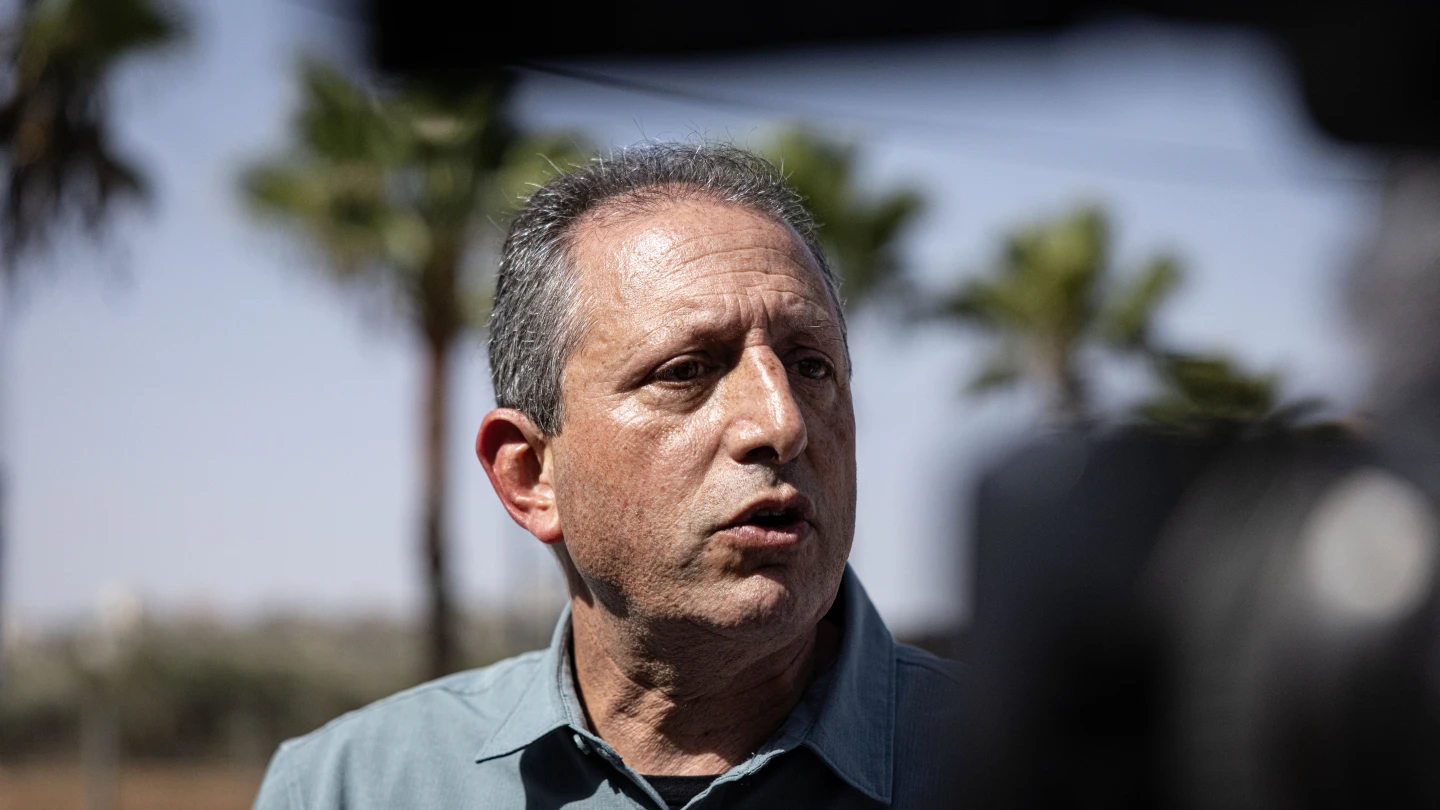
Brad Lander, former New York City comptroller and Democratic nominee for what is considered a safe congressional seat, moved so quickly from grief to decrying Israel in a statement that his sympathy comes off as “subordinate to his political message,” a writing instructor told JNS.
On Oct. 23, Lander, who was arrested in Israel and briefly held, stated that he was “grieving the deaths of the two Israeli soldiers killed in Hebron today and praying for the full and speedy recovery of those who were injured.”
In the next paragraph, he wrote that “I’ve spoken out loudly this week against Israel’s occupation of the West Bank, which imposes violence on a daily basis, and I will continue to do so. But violence is not the path to ending it or to achieving safety, freedom and peace for both Palestinians and Israelis.”
He added that “neither is collective punishment or ethnic cleansing of an entire neighborhood, or punishing millions of people for the criminal act of two, which Netanyahu has promised to enact in response.”
“I’ve seen a lot this week and I’ll have more to say about in the coming days,” he said, referring to an “excruciating cycle of violence.”
“It starts by insisting that every life is sacred, that everyone is created in God’s image,” he wrote. “For now: Shabbat Shalom to everyone who believes in the hard work of making peace and justice a reality, for everyone.”
Vicki Kolomensky, an Ohio-based tutor, academic coach and independent researcher, told JNS that “rather than allowing the deaths to stand on their own as a moment of shared grief,” Lander “turns the expression of sympathy into a preface to a larger political argument.”
“The effect is to make the grief feel qualified, and the soldiers’ murders worth qualifying,” she said.
The Israeli military announced that Palestinian terrorists killed Staff Sgt. Ron Yonatan Roytman, 23, and Sgt. Yuval Shai Svilem, 20, and wounded three other soldiers at a checkpoint near Hebron in Judea that day. Hamas claimed responsibility.
When Lander said “but violence is not the path to ending it,” the word “but” is “doing significant work here,” and the Jewish politician didn’t name the attackers, Kolomensky told JNS.
The second paragraph pivots almost immediately to Lander’s criticism of Israel and “there is also an asymmetry in how violence is framed,” she said.
“Lander identifies the Israeli soldiers as victims but quickly situates their deaths within a broader account of violence,” she told JNS. “He then moves to condemn the Israeli government’s anticipated response.”
“These are not inherently incompatible positions. One can condemn an attack, oppose occupation and reject collective punishment,” she said. “But he speeds the reader along at such a pace that the event that prompted the statement recedes while the indictment of Israeli policy takes center stage.”
Lander’s final paragraph tries to bring the competing threads together through a “universal moral appeal that is familiar to liberal American Jews—every life is sacred, everyone is created in God’s image and peace and justice must be pursued for everyone,” and concluding with “Shabbat shalom” reinforces that appeal with Jewish language, according to Kolomensky.
“But the universalism of the conclusion sits alongside language that is sharply accusatory toward Israel, leaving readers to decide whether the statement has successfully bridged that tension or simply asserted a moral ideal,” she told JNS.
‘A broader political argument’
Kolomensky compared Lander’s post with New York City Mayor Zohran Mamdani’s statement on the third anniversary of Oct. 7, in which the mayor again accused the Jewish state of “genocide.”
“In both cases, the initial acknowledgment of Israeli or Jewish suffering is quickly subordinated to a broader political argument” and “condemnation of Israel,” she told JNS.
Sara Yael Hirschhorn, a historian who specializes in the Israeli-Palestinian conflict and a visiting professor at the University of Haifa, told JNS that to understand the message Lander was trying to send, readers should consider the context in which he wrote it.
“We have to acknowledge that this took place during a trip, with little apparent connection to the business of his constituents of New York City, to the Palestinian territories as part of a ‘protective presence’ cohort for picking olives with Palestinians, which had produced his own photo promotional opportunity,” she said.
Lander’s trip had a “performative and publicity-oriented aspect,” followed by a statement that “‘all-sides’ the complexity of the Israeli-Palestinian conflict,” she told JNS.
Lander’s position that there is an “excruciating cycle of violence” in Judea and Samaria is not wrong, according to Hirschhorn.
But his “foreign policy positions and his alliance with pro-Palestine politicians at home, including those that have endangered local Jewish communities in New York City, suggest that his grasp of the realities of Israel-Palestine and a ‘path’ forward are often polemical and partisan,” she told JNS.
Lander would probably be better off serving “the interests of peace and justice for his citizens in Brooklyn than the West Bank,” she said, “until he becomes more deeply conversant in the Israeli-Palestinian conflict.”
For Kolomensky, the statement’s effectiveness ultimately depends on who consumes it.
“For readers who already share his analysis, the statement may seem consistent and morally clear,” she told JNS. “For others, the rapid pivot can make the opening expression of solidarity feel more obligatory than central.”