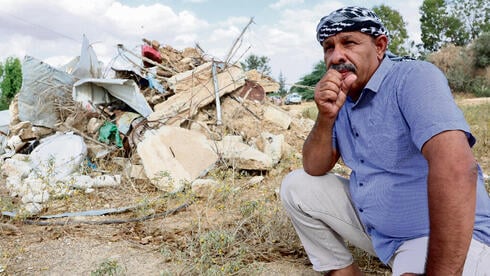
We sat beneath an old ficus tree and asked Jaber Abu Assa which of the piles of shattered concrete and protruding steel rods had once been his home. All around us lay the rubble of what was once the unrecognized Bedouin village of Wadi al-Khalil, just a few dozen yards east of Highway 60, near the Tel Shoket interchange.
Until May 8, 2024, 70 houses stood here, home to 70 families comprising about 400 Israeli Bedouins from the Negev. All that remains of what was once a living community are mounds of beams, broken concrete blocks, drywall and shattered ceramic tiles. Lives reduced to rubble.
How many of us heard about the destruction of this community, the demolition of 70 homes in a single day? It began at 8 a.m. and ended shortly before 5 p.m. Ten bulldozers were deployed for the operation, protected by 2,000 police officers.
We searched online for the news headlines from that day. They reported on the progress of the Israeli military operation in Rafah, negotiations over a hostage deal and ceasefire and a confrontation between Israel and the Biden administration over military aid. Not a word about the demolition of 70 homes in Wadi al-Khalil, just a few minutes’ drive from the little square of chocolate served with coffee at the nearest Aroma café.
“The disagreement wasn’t about leaving this place, but about where we would go,” Abu Assa says. “They want to expand Highway 6 through this land, and the state said it would give us an alternative site in the Al-Muthali neighborhood of Tel Sheva. We said fine. But after we agreed, the state went back on its word and said that instead of Tel Sheva, we would move to land in Umm Batin.
“That land is the subject of a dispute between families, and we said we didn’t want to move into an area of conflict. We didn’t want to get into a dispute with anyone. I’m telling you all this because there had been a dialogue and various ideas were being discussed, until Ben-Gvir intervened. He said enough talking and gave the order to demolish our homes. Just demolish them.
“We got one day’s notice. What can you take from your home in a single day? There were some terrible scenes here. Children, elderly people, entire families were left homeless. Some people put up tents next to the ruins of their homes, and a day or two later inspectors came and demolished the tents too. They gave us no alternative. They threw us out onto the street, literally.
“The state demolished 6,000 homes in the Bedouin communities of the Negev, and Ben-Gvir made TikTok videos about it. ‘I’m in charge, I’m the boss, me, me, me.’
“People had been waiting a long time for this week’s election. We understood that the people really running this terrible government weren’t Likud, but Ben-Gvir and Smotrich, who demolish people’s homes and enjoy doing it. They turn it into a campaign.
“We waited for the election so we could replace a government that didn’t want to talk to us, that only wanted to humiliate us and trample on us, to ignore us as though we didn’t exist. With one hand, they legalized illegal outposts in the territories, outposts that sprang up overnight like thieves in the night, and with the other hand, they crushed us. They didn’t see us as human beings with basic rights.
“We were literally counting the days until the election. You should have seen the lines at the polling stations here in the Negev. People stood in line for an hour, sometimes longer, just to vote.”
The blood toll paid by Arab society under the far-right government has been unbearable. During Itamar Ben-Gvir’s four years as the minister responsible for the Israel Police, 913 Arab citizens were murdered.
That is a number worth reading several times to grasp the magnitude of the crisis facing this community. The fear and insecurity are so pervasive that people are afraid to leave their homes after dark. In far too many communities, the sound of bursts of gunfire is now met with indifference.
In any properly functioning country, a commission of inquiry would be established to investigate how things reached such a level of lawlessness, a reality in which criminal gangs control entire communities.
Arab Israelis certainly turned out in droves, and they had every reason in the world to do so. While the bloc seeking to replace Netanyahu failed to secure a majority over his political camp, voter turnout in Arab society approached 80%, with Arab parties winning 19 Knesset seats as of this writing.
Issawi Frej, a former Knesset member and minister from the Meretz party who lives in Kafr Qasim, says Arab voters needed no encouragement to go to the polls.
“It’s like a soccer team preparing for a decisive match, with the tension building as the game gets closer,” he explains. “When the moment finally comes and the referee blows the opening whistle, the players charge onto the field fired up. That’s what happened with us. We exploded onto the field.
“The desire and willingness to vote were extraordinary. People asked me every day, ‘So, when is the election?’ There was no need for any campaign. Believe me, the parties barely campaigned.
“Look what happened in Umm al-Fahm. In the previous election, turnout there was 41%. This time it jumped to 75.7%.
“What people had in mind was a video from a wedding in the city where police showed up and forced 300 guests to lie on the ground, including the bride and groom. Enough was enough. That alone was sufficient to get people to the polls.
“Or take Kafr Qasim, for example. Here, election day was sluggish until noon. There were no lines and not much enthusiasm. But then Ben-Gvir showed up at the entrance to the city and made a video declaring, ‘I’m the boss here. I’m the tough guy.’
“The young people saw it on TikTok and went crazy. Listen to me carefully: That video spread like wildfire on TikTok. And just as quickly as it spread, people here rushed to the polls after seeing it.
“Kafr Qasim ended election day with a historic turnout of 86%. In Majd al-Krum, turnout reached 83%. At three polling stations there, it reached 100%.
“You know why? It was all ‘thanks’ to the hilltop youth who tried to establish a settlement right on the village’s doorstep.”
Is this Judaism?
We were sitting at a café at the Tel Shoket junction when several young men approached us and asked what would happen next.
One of them said, “The right won’t accept the results in our communities. You’ll see. They’ll accuse us of all kinds of lies.”
And indeed, a few hours later, Likud issued a special statement accusing the Arab parties of “stealing the election through serious criminal offenses.”
Raed Abu Al-Qiyan, a social activist from Hura and a member of the Negev Arab Steering Committee, says people went to the polls because their lives were at stake.
“To live, to live with dignity, like human beings,” he says. “Nobody needed to be encouraged.
“You have to understand, throughout our lives, we always had an open door in the government, including under Netanyahu’s previous governments. We didn’t get the budgets we should have, and there wasn’t enough investment in our communities, but there was always someone who listened to us, heard what we had to say and tried to help.
“Under this Ben-Gvir government, every door was closed to us. What more motivation did I need to vote in a situation like that? Ben-Gvir was our motivation.
“You want to find out why we turned out? Go to his TikTok. Look into it there. He celebrated the demolition of our homes at the expense of the suffering of people left without a roof over their heads.
“And I’ll tell you something else. We have thousands of teachers, doctors, nurses, people with doctorates and professors in academia. We live among Jews. I myself am an environmentalist. I’m not a kid anymore. I’m 49.
“We went to vote to save you from yourselves, too. The Judaism of Ben-Gvir and Smotrich is not the Judaism I know. Their Judaism does not respect other people, does not respect those who are different. They have no compassion for the suffering of others.”
We sat there for half an hour, and at every table around us, people were discussing the election results. Everyone said this had been the largest protest vote in the history of Arab society in Israel.
Social activist Abu Latif Ezzedine from Rahat argued that the massive turnout was a clear and unequivocal statement by Arab citizens that they want to be significant players in the political system.
“We wanted to say that we are Israeli citizens no less than you are, with the understanding that this is the only way to influence our lives and help ourselves,” he says.
“Voting in elections strengthens my sense of belonging. It’s knowing that there is one place where I have exactly the same right as you do as a Jewish Israeli: to put my ballot in an envelope and drop it into the ballot box.
“I’m not bothered by all the accusations. Let those making false claims about irregularities say whatever they want.
“Nine residents of our city have been murdered since the beginning of the year. That alone was a strong enough reason for us to turn out in large numbers, vote and make our voices heard.”
Not even a kind word
Visit an Arab city or village in the Negev, the Triangle region in central Israel or the Galilee sometime. The disparity immediately hits you.
It is visible everywhere, in every aspect of public space: the potholed roads, the missing streetlights, the bare traffic circles because there is no budget for plants and landscaping. These are things that we Jews take for granted.
This week, Arab citizens wanted a say in how their lives in this country would unfold.
Ignoring their massive turnout would have devastating consequences. Everyone we spoke to said so.
“If we end up going to another election, Arab society will have suffered a huge defeat,” Ezzedine says.
“People had hope that they could make a difference, bring about change and bring down the government. Another election would seriously undermine their motivation to vote again.
“People will say, ‘We tried to make a difference, and nobody counted us. Why should we bother voting again?’
“Think about how deeply hurtful it is to us as human beings to realize that we are not seen as partners.
“Bibi’s right-wing bloc talks about a Jewish majority. The bloc seeking change talks about a Zionist majority. But nobody talks about an Israeli majority.
“After all, I’m not Jewish and I’m not a Zionist. I’m simply Israeli. Count us among the Israelis. With us, there is a majority in the Knesset. The arithmetic is so simple.”
Frej, from Kafr Qasim, says that less than 24 hours after the polls closed, a profound sense of frustration was already taking hold in Arab society.
“We came out to vote with our children and our elderly to bring down this terrible government, and we haven’t heard a single thank-you from Eisenkot for our participation. Not one word of thanks for going out to vote to make this place better, more sane. Not even one small kind word.
“That is not leadership.
“Listen to me carefully. Another election would be a huge victory for Netanyahu, but more than that, it would be a knockout blow to the liberal-democratic camp for many years to come.
“It would destroy the hope for change for generations. Generations, I’m telling you.
“We are at a defining moment in Israeli history, and the bloc seeking change must not miss it. It would be a tragedy for Israel and for the entire region.”
Abu Assa also sounds pessimistic.
As we sifted through the pile of broken concrete blocks that had once been his home, he told us that the residents had scattered among Bedouin communities in the area. Some rented rooms, while others found shelter with relatives in Segev Shalom, Umm Batin and Lakiya.
They receive no money from the state.
“With our votes, we wanted to send a message that this extremism in the way we are treated is unacceptable to us,” he concludes.
“People are no longer willing to suffer. If people see that their votes are disregarded, what are they supposed to understand? You tell me. What will we conclude if our votes have no meaning at all?
“People will reach a point of despair. That’s what will happen.
“Look how they demolished our home and gave us no alternative, no solution. It’s an unforgivable crime.
“People went to vote so they would be seen, so their votes would bring change. If they realize it doesn’t help, things could turn violent.
“Look how they left us with nothing,” he says, pointing to the mound of rubble that had once been his home and his children’s home.
“They left us abandoned like dogs.”