When Fatima Ezzahra El Mansouri became Morocco’s first female prime minister last month, reporters called Jacky Kadoch for comment. Years ago, on Yom Kippur, El Mansouri, the then-mayor of Marrakech, had come to Kadoch’s synagogue and asked him to bless her.
Kadoch, now 72 and president of Marrakech’s Jewish community, is tired of telling the story. “You cannot imagine how many Muslim people, intelligent, modern people, men and women, come to ask for a blessing. She asked like everybody else.”
What Morocco’s Jews want from El Mansouri’s government now is help getting their own community elections, ordered by King Mohammed VI in 2022 and still not held.
No one has an exact count of Morocco’s Jewish population. In 1948 it numbered approximately 250,000. Serge Berdugo, the longtime secretary general of the Council of Jewish Communities of Morocco, puts it at about 2,500 today. Others estimate there are only between 1,000 and 1,500 Jews in Morocco.
Under the existing rules, women cannot vote and members cannot choose their community presidents.
Under Morocco’s constitution, the prime minister runs the economy, schools and hospitals. Security, foreign policy, including relations with Israel, and religion are the king’s domain. As such, the Jewish communities are governed through the palace. The 2011 constitution designated the Hebrew heritage as part of the national identity, but Jewish family matters are still settled in rabbinic chambers, which exist inside Moroccan courts. Meanwhile, each city’s Jewish community has its own governing committee—in Casablanca, Rabat, Marrakech, Meknes, Fez, Tangier, Tetouan and Agadir—and the council serves as their umbrella. (Incidentally, Berdugo, 88, is also the king’s ambassador-at-large.)
But the Jewish communities still run on rules written in 1945, under Mohammed V. Their committees were last elected in 1969, in the hostile climate after the Six-Day War, and members who died since have been replaced by people the remaining members chose. As early as 2003 the historian Robert Assaraf called the 1945 structure “definitively obsolete.”
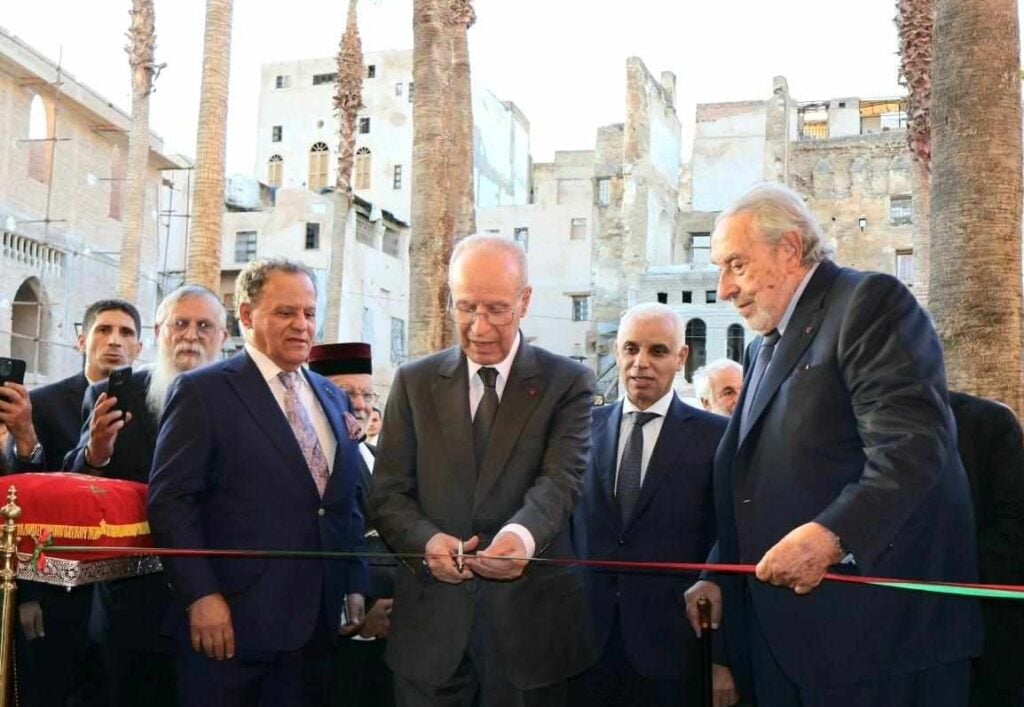
Ahmed Toufiq, Morocco’s minister of Islamic affairs, cuts the ribbon at the opening of the Museum of Moroccan Jewish Culture on October 12, 2026. Serge Berdugo, head of the Council of Jewish Communities of Morocco, is on the right holding the ribbon. (Courtesy of Serge Berdugo)
Most of Morocco’s Jews now live in Casablanca, which still has about 15 synagogues, open morning and evening, along with kosher butchers and Jewish clubs. Gabriel Elharar, 64, a dentist who trained in France, came home more than 30 years ago and stayed. “Moroccan Jews are deeply attached to their country and its king,” he says. He works wearing a kippah, and most of his patients are not Jews. Once, he said, a Lebanese Christian stopped him in the middle of a treatment. “You, the Jew with your kippah, and your Muslim assistant in her headscarf, ganging up on a Christian!” the patient joked. He was in awe of seeing the three religions so visibly intersecting. “That is Morocco,” says Elharar.
Tamar Borros, a Casablancan shoe designer, says the same about her workshop, where some of her Muslim employees have been with her for decades. “Although I am Jewish and they are Muslim, we respect each other. We are like a family,” she says. “I did a man’s job, and I never had to suffer for being a woman.”
Jewish children in Casablanca go from the Neve Shalom primary school to the Ecole Normale Hebraique, a Jewish high school, and earn the French baccalaureate diploma. “After, they all go and build their lives elsewhere,” Borros says. All eight of her children live in Israel, where Moroccan Jews number nearly 1 million, about one in eight Israeli Jews. When young people leave, she says, the parents end up following them. “That is how the community has shrunk.”
“Moroccan Jewish life cannot and should not be reduced to Casablanca alone.”
Around 2019, Elharar and 10 or 15 other Moroccan Jews wrote to the king asking that the communities be run democratically. Under the existing rules, women cannot vote and members cannot choose their community presidents. That April the king ordered the Interior Ministry to organize regular elections for the communities. Then came Covid.
In 2022 the king ordered a new structure for the communities’ institutions. A decree published that November set out to create a 24-member national council—half to be appointed by the king and half to be elected by regional vote and to be overseen by a president appointed by the king—along with a commission for Jews abroad and a foundation. The 24-member council would replace Berdugo’s existing one. The new bodies were to be in place within a year, but nearly three years past that deadline, the Interior Ministry has yet to set the rules for the vote. In Berdugo’s estimation, “The institutions continue to function normally,” meaning under the 1945 rules.
Flora Perez, who with Borros runs the aid group Kesher (started by a handful of Jewish business owners during the pandemic), wants the vote now. “It is essential today to hold elections,” she says, describing institutions, from the rabbinate and kashrut to the schools, as run sloppily by a few people that have a stranglehold on them. “All these lights are a bit dark today, and no room is left for new blood,” she says. “We need much more visibility, much more transparency.” Elharar echoes this idea: “Today, we must know how to pass on the responsibility for leading the community to a next generation.”
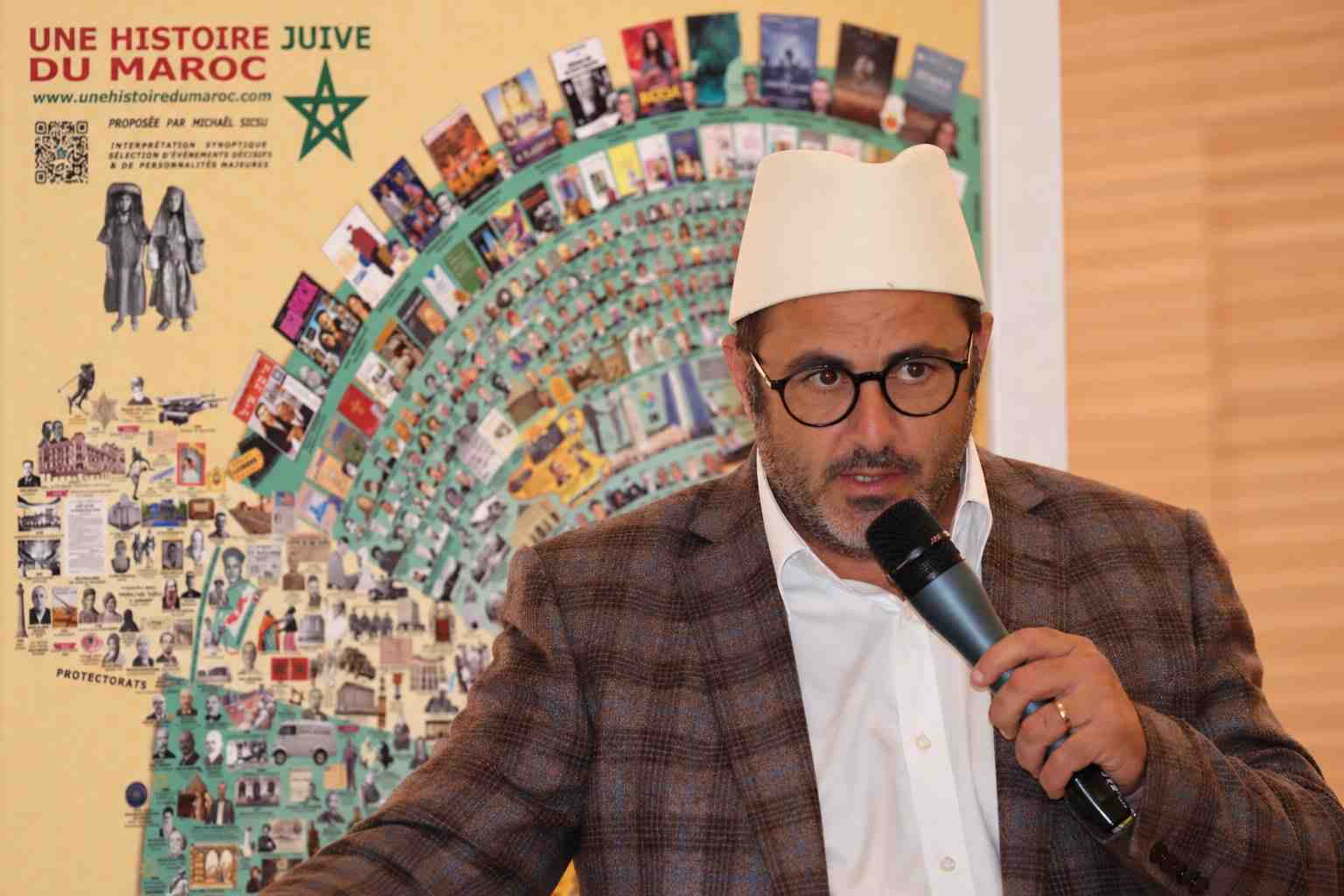
Kadoch would drop local elections and build one strong central office in Casablanca, pointing to the fact that Tangier has only 30 or 40 Jews. “When you are in a city without a minyan, it is finished,” he says. Michael Sicsu, who leads the small Jewish community in Agadir, a coastal city south of Marrakech, calls Kadoch a central figure whose dynamism others should follow. But he would keep the regional seats. “Moroccan Jewish life cannot and should not be reduced to Casablanca alone,” he says.
Faical Marjani, a Muslim Rabat banker, founded the group Maroc Coexistence in 2010 to promote Muslim-Jewish dialogue and has become a leading voice for ties with Israel among younger Moroccans. He says bluntly what Jewish leaders say quietly. In an Arabic-language column on the Moroccan news site Siyassi on October 12, he wrote that the king’s 2022 instructions had yet to be carried out. “The Moroccan Jewish community is neither a mere historical memory nor a decorative element in political discourse,” he wrote, adding that the community’s head (he didn’t name Berdugo) suffers from “old age and poor health,” and questioning how such a leader could represent it amid “the rapid changes Morocco and the world are going through.”
The national council answers to the palace, and the Interior Ministry writes the election rules. Abdelouafi Laftit, the interior minister who has yet to set them, kept his post in El Mansouri’s cabinet. Still, El Mansouri comes to the job with long ties to Marrakech’s Jewish community.
Her father, a former pasha of Marrakech (meaning the city’s royally appointed administrator) who later served as Morocco’s ambassador to the United Arab Emirates, was a friend of Kadoch’s late father. Sicsu recalls that El Mansouri attended a French school in Marrakech “in a class with a lot of Moroccan Jews,” surmising, “It is not hard for her to live with Jews.”
King Mohammed VI, enthroned in 1999 at the age of 35 after his father died, named El Mansouri, 50, head of government on September 29. This came after her Authenticity and Modernity Party (PAM) won 97 of 395 seats, the most of any party. (PAM was founded in part as a counterweight to the Islamist Justice and Development Party.)
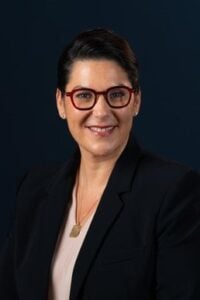
Official Pressroom portrait of Moroccan Head of Government Fatima Ezzahra El Mansouri.
El Mansouri is a lawyer who studied in Montpellier, France, and in the United States. In 2009, at the age of 33, she became the first woman elected mayor of Marrakech. In 2021, she became housing minister. Kadoch notes that as mayor, she hosted delegations from Marrakech’s Jewish community at her home. A Marrakech businessman close to the palace and to the community’s leadership, who asked not to be named, expects Kadoch to become the unofficial point man between Morocco and Israel, and for Jewish organizations abroad.
Moroccan Jews have voted as full citizens in Morocco’s general elections since independence, although there are currently no seats reserved for them in the Moroccan Parliament. “Personally, I have never felt the need or desire for Moroccan Jews to be automatically allocated a seat in Parliament, as is the case for the Jewish minority in Iran,” says Sicsu. With only about 1,300 Jews left, he says, such a seat “would give us representation far beyond our demographic weight,” adding, “the Moroccan state already does an excellent job of protecting our rights and interests.” Elections for the Jewish communities, again decreed back in 2022, are a separate matter.
Elharar hopes the Jewish communities in Morocco grow and strengthen their institutions, but he worries about how young Moroccans see their Jewish neighbors. “It is a marriage of reason, not of love,” he says. “The new generation risks seeing Jews only through the prism of the Israeli-Palestinian conflict.”
In the general elections held in September, the Islamist Justice and Development Party (PJD) rose from 13 seats to 54, and marches against normalization with Israel followed. And yet, Sicsu notes, it was a PJD prime minister, Saad Eddine El Othmani, who signed the December 2020 accord that restored Morocco’s diplomatic ties with Israel. “If they insist on protesting,” he says, “perhaps they would do better to demonstrate outside their own party’s headquarters.”
Chama Mechtaly, a Casablanca-born activist, left Morocco in 2015 after the PJD-led government banned and censored her art and callers phoned her with threats. “They came back, but they don’t have the majority,” she says. “They will be a louder opposition, but with no governing power whatsoever.” With PAM leading the government, she says, the palace and the government are more closely aligned, which she sees as necessary “to translate the agreements [with Israel] into real people-to-people initiatives.”
Unlike Elharar, she’s encouraged by the attitude she sees Moroccans reflecting. “For the first time we’re seeing average people, men, women, all ages—going on social media to say: We stand with Israel, we stand with the United States, those are our real friends,” she says.
Gadi Eisenkot, whose father was born in Marrakech, led the main challenge to Benjamin Netanyahu in Israel’s October 27 election, which left neither side with a majority. His Yashar party’s posters in Beersheba and other towns called him “Rosh Memshala Dialna,” the Hebrew for “prime minister” joined to the Moroccan Arabic for “ours.” “At the end of the day he is Moroccan,” Mechtaly says, adding that if he becomes prime minister “we’ll see an unprecedented level of cooperation between Israel and Morocco, out in public, in ways we’ve never seen or anticipated.”
Regardless, Morocco’s Jews still want their own elections, and Sicsu wants something like a Jewish Agency in reverse to bring diaspora Jews to Morocco. Mechtaly hears the same talk among Moroccans abroad. If the new El Mansouri government keeps its promises, she says, “it may soon be time to go back home.”
Image at top: Michael Sicsu, who leads Agadir’s Jewish community, lectures on the history of Moroccan Jewry at Cadi Ayyad University in Marrakech. (Credit: Paul Dahan)