Baghdad museum showcases Jewish heyday, as memory of lost community gingerly rekindled
Shamash Jewish Museum, opened in former school belonging to tiny remnant of once-thriving community, attracts dozens of visitors, but unclear who is behind latest project preserving symbols of Jewish life
Hanukkah menorahs, a kippah and a prayer shawl, alongside historical papers and videos, are among the items on display at a new museum that opened in Baghdad recently, the first of its kind dedicated to documenting the history of Iraq’s once-vibrant Jewish community.
The project, a rare instance of homage to the flourishing of Jewish life in the city, has received attention in the Arab press and social media. Yet the identities of those behind the museum and the extent of official support remain unclear.
In the early 20th century, Iraq was home to over 100,000 Jews, who made up roughly a quarter of Baghdad’s population. Growing antisemitism culminated in the Farhud, a 1941 pogrom, and continued following Israel’s establishment in 1948, leading the overwhelming majority of Iraqi Jews to flee, mostly to Israel.
Only a handful of Jews remain in the country today. Yitzhak Horowitz, who entered Iraq under an assumed identity several months ago and met with members of the Jewish community, told Channel 14 following his visit that only five or six Jews remain in the city.
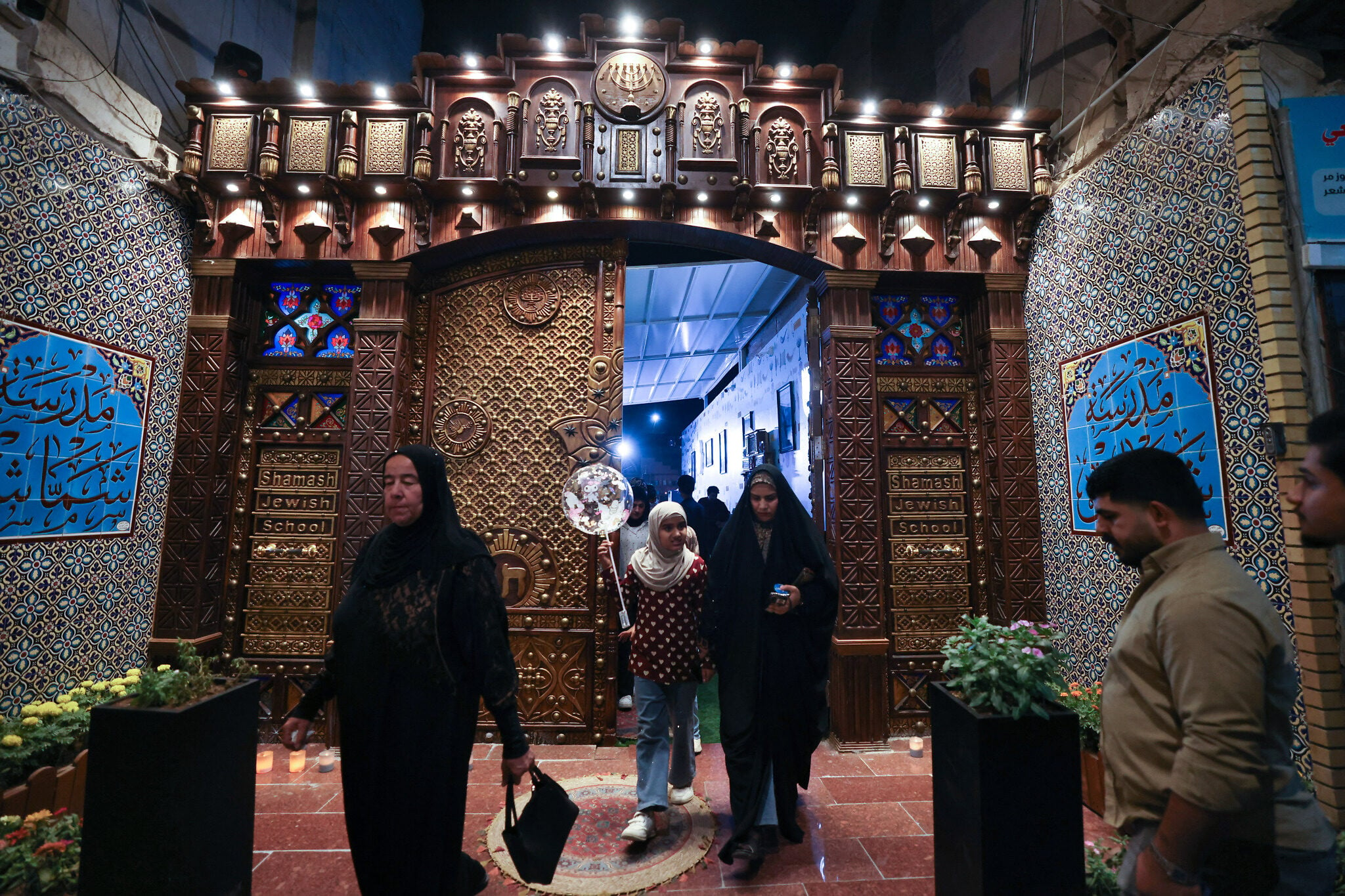
The Shamash Jewish Museum on Baghdad’s al-Rashid street, in the heart of the capital, sits at the site of what was once the Shamash School, which was founded in 1928 to serve the burgeoning community.
Inside the museum, visitors can see documents chronicling Jewish communal life, religious artifacts and filmed interviews with Jews who once lived in Iraq, apparently recorded outside the country.
افتتاح #متحف_شماش_اليهودي في شارع الرشيد بالعاصمة #بغداد
– هو أول متحف في العراق مخصصر بالكامل لتوثيق تاريخ ومقتنيات وتراث الطائفة اليهودية العراقية
Advertisement
– المتحف يمثل مبادرة ثقافية تهدف إلى إحياء الذاكرة التعددية لمدينة بغداد، ويضم عدة أقسام ومحتويات رئيسية
— ???????? AL IRAQY NEWS – العراقي نيوز (@ALIRAQYNEWS) October 31, 2026
“It’s the only museum in Iraq belonging to the Jewish community,” Ammar al-Tamimi, lawyer for the committee of Iraqi Jews that manages the community’s properties, told AFP.
The Iraqi government has made no official announcement about the museum’s opening, nor has the country’s official news agency reported on it.
The government confiscated the Shamash school property in the 1970s and converted it into a public school, until a court ruling returned it to the community in 1992, according to Tamimi.
Efforts to revive the school faced successive setbacks: sanctions in the 1990s, the US invasion of 2003, sectarian clashes in 2006 and 2007, and the rise of the Islamic State terror group between 2014 and 2017.
In an interview with the Saudi Al Hadath channel, Tamimi appeared to indicate that the project had been carried out with the approval of local authorities.
“The Jewish endowment has existed in Iraq for years. Even after the Jews emigrated, the Farhud took place, political upheavals occurred and only a few people remained, there was still an administration overseeing the endowment,” he told the station.
Organizations based outside Iraq and dedicated to preserving Iraqi Jewish heritage have also been involved in efforts surrounding the project.
The American organization JIMENA, which works to preserve Sephardic and Mizrahi Jewish heritage, issued a statement following the circulation of footage of the museum on social media, acknowledging that in early October it had met with Iraqis leading the restoration of the Shamash School, which now houses the museum, and had followed their work.
However, the organization provided no further details, stressing that it was withholding details of those involved in Iraq out of concern for their safety.
Beyond the question of who restored the building, it remains unclear where the numerous items displayed in the museum came from and whether members of the Jewish community were involved in collecting them.
The museum, with its large wooden entrance topped by menorahs and stained-glass geometric patterns, consists of a hall displaying antique documents and photographs of Iraqi Jews, along with old school certificates.
Its walls are adorned with photos of prominent Jewish figures, including Iraq’s first finance minister Sassoon Eskell (1860–1932) and physician Dhafer Fouad Eliyahu (1960–2021), who was well known in Iraq for providing free services.
The museum has welcomed dozens of visitors, both local and foreign, since opening, according to AFP.
“The entire museum is beautiful — the photographs, the testimonies,” an Iraqi visitor told al-Hadath.
Visiting the museum, 74-year-old Ramzi al-Saadi recalled his Jewish neighbors as a child on Baghdad’s al-Kifah Street. “They were kind, simple people who never harmed anyone,” he told AFP.
Revived preservation effort
The museum is the second initiative in Baghdad over the past year aimed at preserving Iraq’s Jewish heritage.
In November 2025, it was reported that the tomb of Rabbi Isaac Gaon, one of the country’s prominent Jewish religious figures, who died more than 1,000 years ago, had been restored and renovated in Baghdad.
In that case, the $150,000 restoration project was reportedly funded by Iraq’s Jewish community — which likely was aided by donors living abroad — with limited involvement from Iraqi government bodies.
When Iraq was home to a large Jewish population, Rabbi Isaac Gaon’s tomb was a pilgrimage site that included several synagogues. Following the departure of most of the country’s Jews, however, the site fell into neglect and became filled with garbage.
Today, fewer than 50 synagogues and Jewish sites remain in Iraq, most of them in Baghdad and Hilla, the capital of Babylon Province, to which large numbers of Jews were forcibly taken in what became known as the Babylonian exile in the sixth century BCE.
For years, the Iraqi Jewish community has been working to restore its shrines and synagogues, which have suffered from severe neglect, and many of which were turned into warehouses or destroyed during the wars that have plagued Iraq.
In 2022, a tomb said to belong to the biblical prophet Nahum and an adjacent synagogue were reopened in the small Christian town of Alqosh in Iraqi Kurdistan, following a secretive restoration project backed by the US government and local Kurdish authorities.
Iraq has undergone dramatic political upheavals over the past two decades, from the US-led invasion in 2003 and the fall of Saddam Hussein’s regime to the political system in place today, in which Iranian-backed and Shiite political forces wield considerable influence amid persistent sectarian tensions.
Outside the autonomous Kurdish region, Iraq maintains an official policy of hostility toward Israel. The country is also home to pro-Iranian militias that have launched drones at Israel in recent years as part of Tehran’s so-called Axis of Resistance.
LIMITED TIME OFFER: Join The Times of Israel Community today, and you’ll receive a physical book of your choice, carefully curated by our editors.
Choose between two must-reads: When We See You Again by Rachel Goldberg-Polin, a searing portrait of a mother’s grief and strength following unthinkable tragedy;
Or Out of the Sky: Heroism and Rebirth in Nazi Europe by Matti Friedman, the gripping and surprising tale of a forgotten moment during World War II.
As a Community member, you’ll also enjoy our outstanding DocuNation series of Israeli documentary films, an ad-free experience of our site and podcasts, commenting privileges, and more.
We’re really pleased that you’ve read X Times of Israel articles in the past month.
That’s why we started the Times of Israel – to provide discerning readers like you with must-read coverage of Israel and the Jewish world.
So now we have a request. Unlike other news outlets, we haven’t put up a paywall. But as the journalism we do is costly, we invite readers for whom The Times of Israel has become important to help support our work by joining The Times of Israel Community.
For as little as $6 a month you can help support our quality journalism while enjoying The Times of Israel AD-FREE, as well as accessing exclusive content available only to Times of Israel Community members.
Thank you,
David Horovitz, Founding Editor of The Times of Israel
The Times of Israel Community.