Israel’s traumas, absurdities come into focus via a veteran photojournalist’s lens
New retrospective ‘Alex Levac: Black Box’ offers a selection of celebrated works from the last 50 years as the country grapples with some of the greatest challenges in its history
Alex Levac didn’t set out to be a photojournalist. But over the last 60 years, his camera has captured raw, potent images of Israeli life — from its everyday absurdities to its sometimes violent struggle for existence.
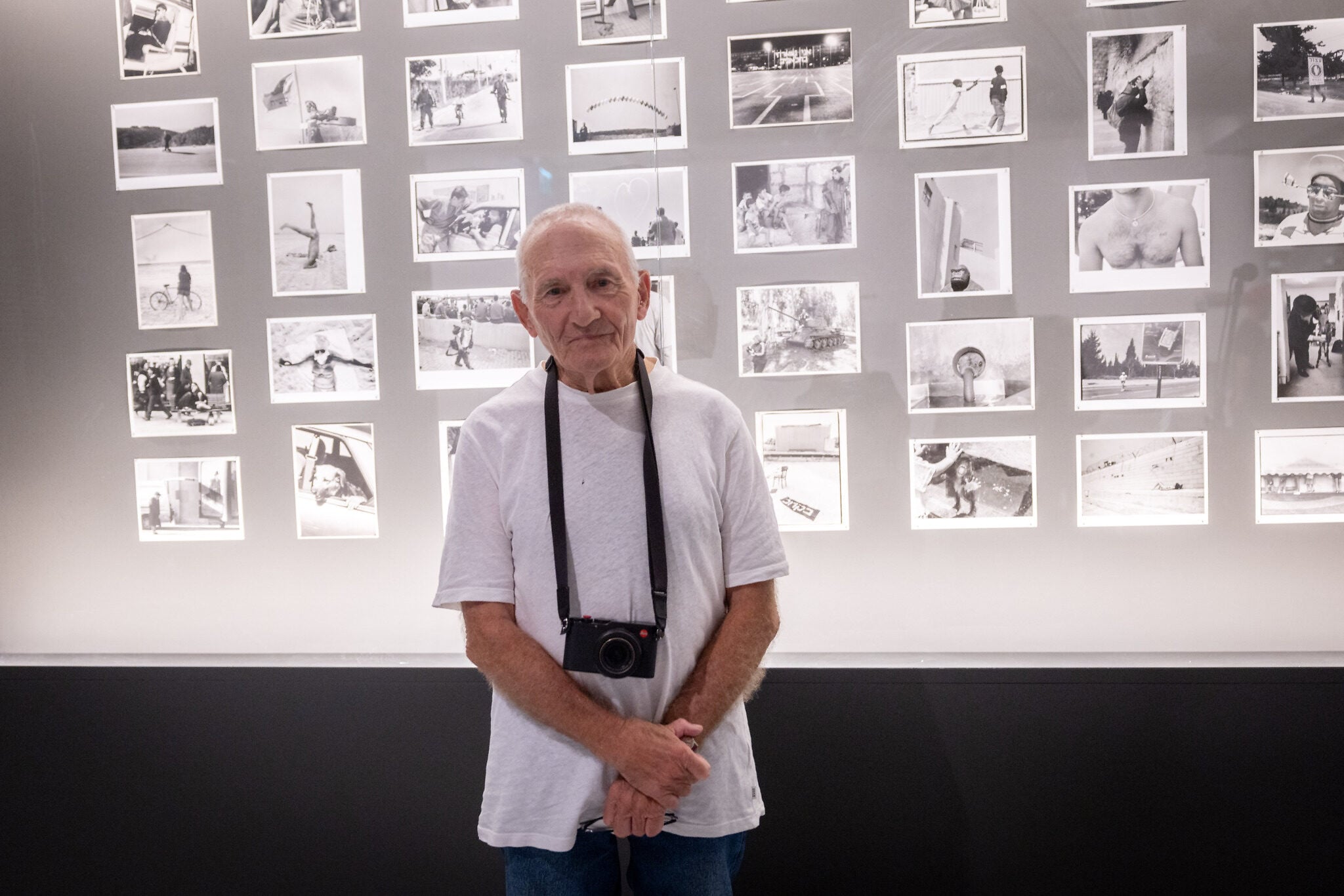
Some 250 of those photographs are exhibited in “Alex Levac: Black Box,” which opened October 27 at the Eyal Ofer Pavilion, an annex of the Tel Aviv Museum of Art. The display runs through May 1, 2027.
The museum’s curatorial staff chose to open the show on Israel’s October 27 election day, as Levac’s photographs present some of the country’s most fundamental issues, often showing how little has changed over the last decades.
The first section of the exhibit includes images from Brazil and London in the 1960s and 1970s, taken during Levac’s travels after he finished studying psychology in Israel. It was his experience photographing Brazil, a country with great natural beauty and governed under military rule, that convinced him to study photography in London.
The exhibit includes that first collection of black and white gelatin silver prints Levac developed himself, including images of punks on a London street and a quaint gathering at a village tea party.
Levac shares his own thoughts about his work in the texts set next to each group of photos:
“In London, I understood that the camera lets you express yourself in relation to particular social phenomena,” reads one placard. “To photograph exactly the kind of things I find repugnant — racism, violence — you still have to photograph them. I hoped the camera had a power that could, if not change things, at least show what hadn’t been seen before.”
He returned to Israel in 1981, where he went straight into covering Israel’s streets and conflict zones.
The collection of photos, curated by Levac with the museum’s curatorial team including Tamara Abramovitch, Sophia Berry, Gaston Zvi Ickowicz and Shira Karin, displays the many facets of Levac’s work, particularly how he balanced his coverage of Israel’s conflict for Hadashot and then for Ha’aretz with the more whimsical portraits taken in his free time in Tel Aviv and Jerusalem.
“He shows that you can photograph things you hate,” said Abramovitch.
As a photojournalist, Levac covered the First Lebanon War, the flare-up of the Israeli-Palestinian conflict, the outbreak of the First Intifada, the Oslo Accords, the 1995 assassination of prime minister Yitzhak Rabin, and the Second Intifada.
The exhibit displays gripping imagery from those situations: young Palestinians hurling stones in the First Intifada and the haunting image of two young boys standing at Rabin’s grave, one with a skull drawn on the back of his sweatshirt.
An entire wall is dedicated to the Bus 300 affair, when a bus was hijacked in 1984 by four terrorists who were captured alive and removed from the bus, and killed shortly after by Shin Bet agents.
The news photographers on site, including Levac, instinctively photographed the incident’s first moments.
At the time, Levac wasn’t sure what imagery he had captured and was approached by an agent who demanded his film. He thought quickly and handed the agent an unused roll of film, not wanting to violate the journalistic code by sharing what he’d captured.
Levac’s photo of Majdi Abu Jamah, one of the Bus 300 hijackers, shows the final moments of the terrorist’s life.
It became one of Levac’s most famous photographs for what it revealed, and it forms a central part of the exhibit, showing how the incident was then falsely reported and covered up. The scandal caused upheaval within the Shin Bet, the judicial system, the media and the government, and its portrayal allows viewers to reflect on how the Israeli-Palestinian conflict has shaped the country.
Levac, now 82, is still working, photographing, and always capturing images of what he sees around him.
The upper section of the exhibit shows his most recent work, including his Ha’aretz columns “The 21st Century,” with photos in the weekend supplement, and “The Twilight Zone,” Levac’s weekly work with columnist Gideon Levy, as they report on violence and injustice against Palestinian civilians living in the West Bank.
The exhibit invites Israelis to reflect on the country’s past, on the eve of a consequential election, as they wait to see what happens next.
LIMITED TIME OFFER: Join The Times of Israel Community today and you’ll receive a physical book of your choice, carefully curated by our editors.
Choose between two must-reads: When We See You Again by Rachel Goldberg-Polin, a searing portrait of a mother’s grief and strength following unthinkable tragedy;
Or Out of the Sky: Heroism and Rebirth in Nazi Europe by Matti Friedman, the gripping and surprising tale of a forgotten moment during World War II.
As a Community member, you’ll also enjoy our DocuNation series of outstanding Israeli documentary films, an ad-free experience of our site and podcasts, commenting privileges, and more.
We’re really pleased that you’ve read X Times of Israel articles in the past month.
That’s why we started the Times of Israel – to provide discerning readers like you with must-read coverage of Israel and the Jewish world.
So now we have a request. Unlike other news outlets, we haven’t put up a paywall. But as the journalism we do is costly, we invite readers for whom The Times of Israel has become important to help support our work by joining The Times of Israel Community.
For as little as $6 a month you can help support our quality journalism while enjoying The Times of Israel AD-FREE, as well as accessing exclusive content available only to Times of Israel Community members.
Thank you,
David Horovitz, Founding Editor of The Times of Israel
The Times of Israel Community.