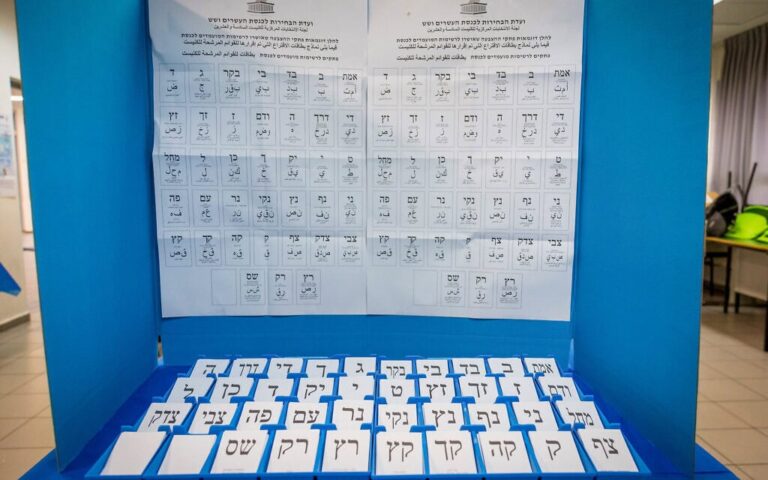
JERUSALEM (VINnews) — Likud MK Amit Halevi has accused foreign-backed organizations and Arab political parties of orchestrating an extensive campaign to manipulate Israel’s October 27 elections, describing the alleged operation as a “hostile takeover” of the country rather than merely an attempt at election fraud.
Join our WhatsApp group
Subscribe to our Daily Roundup Email
In a lengthy statement, Halevi argued that the public had yet to grasp the scale of what he described as an internationally coordinated effort to undermine Israeli democracy, involving foreign funding, alleged vote-buying, voter-tracking technology and the mobilization of hundreds of thousands of Arab voters. “This is not ballot-box fraud, and it is not simply election theft. It is, in fact, a hostile takeover of the State of Israel,” he declared.
Halevi alleged that a network transferring money from Islamist countries, including Qatar, Turkey and Iran, to organizations operating in Israel had been functioning for years. According to his account, funds were routed through European organizations before reaching Israeli civil society groups that he claims serve as fronts for hostile activities.
He pointed to the recent revelations concerning the Ra’am party and the 48 Association, which has been linked to allegations of transferring funds to Hamas, as an example of the broader network he believes is operating in Israel.
According to Halevi, the election campaign represented an unprecedented escalation of these activities, with the alleged objective of increasing Arab voter turnout and securing a decisive political shift against Prime Minister Benjamin Netanyahu’s government.
Halevi claimed that substantial sums of money flowed into Israel through existing networks, allegedly with the encouragement of intermediaries including former Balad MK Azmi Bishara and Hamas political leader Khaled Mashaal.
He further alleged that local political organizations established an extensive infrastructure to distribute the money among regional organizers and mobilize voters.
A central element of the alleged operation, Halevi said, was the use of a voter-monitoring application. He claimed that an Arabic-language version of the Elector software (which was deemed illegal by the election committee) was downloaded by thousands of activists, who allegedly operated registration stations outside polling places, recording which voters had arrived and communicating the information to party organizers.
Halevi said he personally witnessed such stations outside polling places in Arab communities, including tables equipped with computers and envelopes. He alleged that polling station observers passed information to activists outside, despite restrictions imposed by the Central Elections Committee.
He also pointed to alleged cash payments and fuel vouchers distributed to voters, particularly in Bedouin communities in the Negev. The allegations have been accompanied by the arrest of seven Ra’am activists in connection with a suspected vote-buying operation. Police said envelopes containing cash and Ra’am ballot slips were found during the investigation.
The Ra’am party has denied wrongdoing, describing the arrests as politically motivated and intended to undermine Arab voter participation.
Halevi accused Israel’s security establishment of failing to recognize the scale of the alleged operation, arguing that the Shin Bet, Mossad and Military Intelligence had concentrated their attention on possible foreign interference through social media and cyber networks while overlooking the movement of money and the alleged use of local organizations.
He also criticized the legal establishment for restricting security agencies’ ability to investigate organizations operating under the guise of civilian activity.
His accusations come amid a separate Shin Bet investigation into suspected foreign interference, including possible funding from Qatar and Turkey. However, authorities have stressed that the foreign-interference investigation and the police inquiry into suspected vote-buying are separate cases, with no established connection between them.
The allegations have been strongly disputed by election officials and law enforcement authorities. The Central Elections Committee’s acting director-general rejected claims of widespread election fraud, while police said they had no investigative or intelligence evidence supporting the Likud’s broader claims that Arab parties had stolen the election.
Meanwhile, The Shin Bet is growing increasingly frustrated by legal restrictions hampering its investigation into the suspicions of foreign interference in Israel’s elections. Officials in the security agency say the requirement to obtain special approvals for investigative measures is slowing the probe and making it difficult to establish the full truth.
According to a report by Army Radio, despite having compiled a list of key suspects in the affair, the Shin Bet has yet to summon any of them for questioning. The agency says it has not yet received the necessary authorizations to carry out investigative actions, but stresses that it continues to submit requests in an effort to advance the investigation. “It is difficult to get to the truth when our investigations are being restricted,” officials in the agency reportedly complained.
At the center of the dispute is an instruction issued by Attorney General Gali Baharav-Miara, according to which even individuals who are not politicians or public figures themselves, but belong to the close circle or associates of a politician, are to be treated as public figures for the purposes of the investigation. This means that questioning individuals connected to politicians also requires special authorization, imposing additional legal hurdles on investigators.
Meanwhile, the Shin Bet has compiled a list of several key suspects believed to have been involved behind the scenes in transferring foreign funds. Some are reportedly close associates of Arab politicians, while others have no known connection to them.
Regarding the suspected sources of the funding, the Shin Bet’s current assessment is that the money originated in Qatar, Turkey and the Palestinian Authority. According to information gathered so far, investigators have not identified any additional countries as being involved in the affair.