[vc_row][vc_column][vc_column_text woodmart_inline=”no” text_larger=”no”]After a week of headlines, most of us don’t need more information. We need a task with a clear end. Something small, something you can finish before the tea goes cold, and something that doesn’t ask you to have an opinion.
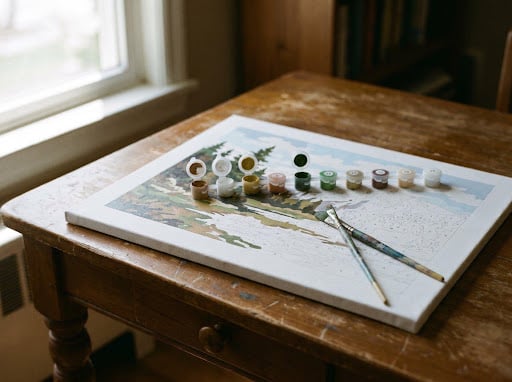
Picture a table, a numbered canvas, and forty minutes that pass without your noticing. Paint by numbers isn’t a cure for anything, and nobody will mistake the result for serious art-world work. But it offers a bounded, finishable kind of making, and for restless, news-saturated minds that’s a more serious offer than it sounds.
Starting With a Kit That Doesn’t Intimidate
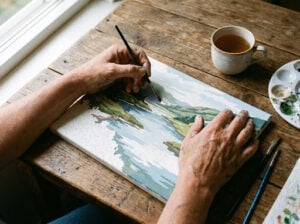
The biggest barrier to making something is the blank page. A numbered canvas removes it. Every shape is outlined, every region carries a number, and every number matches a pot of paint. You don’t decide anything except which section to do next.
Choose a subject you’d actually hang on a wall. A mountain view, an animal, or a loose abstract all work, but a picture you’re lukewarm about will sit half done in a closet. Then look at two numbers: canvas size and color count. A small canvas with fewer colors can be finished in a few sittings, which matters more than ambition for a first attempt. A good kit includes the canvas, acrylic paints, and brushes, so there’s nothing else to buy. If you’d rather skip the hunt for supplies, a Number Artist order online gets you a complete kit, and you can browse by subject first.
A Short History: When America Painted by Number
The format is older than most people assume. Paint by number took shape around 1950 at the Palmer Paint Company in Detroit, where Max Klein and Dan Robbins worked out how to sell ordinary people the experience of painting. The kits, sold under the Craft Master name, cost about $2.50 apiece.
They sold absurdly well. According to Smithsonian Magazine, more than 12 million kits had sold by 1954, and the Smithsonian’s own exhibition on the craze argued that more numbered paintings hung in American homes than original works of art. Critics sneered, of course. Kitsch was the kindest word on offer. The kits sold anyway, because people wanted the satisfaction of making something, not a lecture on what counted as art.
Television eventually cooled the craze, but the argument never ended. Does a picture need to be original to be yours? Anyone who has ever hung a child’s finger painting already knows the answer.
What the Science Says, and What It Doesn’t
Here’s where retailer blogs tend to get carried away, promising dopamine surges and clinical-grade calm. The honest version is more modest, and more believable.
In a 2016 study in the journal Art Therapy, Girija Kaimal and colleagues at Drexel University took saliva samples from 39 healthy adults before and after 45 minutes of art making with collage, clay, and markers. Cortisol levels dropped significantly, falling in about 75 percent of participants, and prior art experience made no difference. Talent, in other words, isn’t a prerequisite for calm.
Now the caveats. That study had no control group, used free-form materials rather than kits, and measured a single sitting. Nobody has studied paint by numbers itself, and none of this research amounts to treatment for anxiety or depression. If you’re struggling, a kit is not a substitute for care.
What the numbers do show is that making is common. The National Endowment for the Arts’ 2022 Survey of Public Participation in the Arts found that roughly half of American adults, 51.8 percent, had created or performed art. The modest claim is the credible one: making things with your hands tends to settle people, and a numbered canvas is an easy way in.
The Jewish Tradition of Making With Your Hands
Readers of this magazine will recognize the impulse. Moment has written about the gatherings in which people relearn candle making, quill cutting, and calligraphy with oak-gall ink, the kind of slow work described in our piece on Jewish ancestral crafts making a comeback. Participants rarely talk about productivity. They talk about being in time differently.
Something similar happened when artist Zoya Cherkassky decided to paint a picture a day through the 2020 lockdown, as we reported in Lost Time: Painting through a Pandemic. A daily canvas gave shapeless weeks a structure.
A numbered kit is humbler than either. It’s no Cherkassky, and it isn’t an ancestral craft. But it shares the rhythm of slow, attentive work, and the same quiet payoff: at the end, there’s a thing that wasn’t there before.
Making the Hour Stick
A few habits help.
- Set a 45-minute session, matching the length used in the Drexel study, and stop when the timer does.
- Put your phone in another room. Rest from screens is half the point.
- Work one color at a time, or move from lightest to darkest, so the canvas fills in steadily.
- Leave small mistakes alone, or paint over them once they dry. Nobody inspects the edges.
- Finish it, then hang it. An unfinished canvas becomes one more open loop.
It also works as a shared project. A kid, a parent, or a houseguest can take a corner while you take another, and the finished picture makes a better gift than most things you could buy.
The Finished Thing
Small finished things count. You don’t need talent, a rationale, or a free weekend, only a table and an hour you’ve decided not to spend scrolling. The picture may never hang in a museum. It will, though, be done, and that’s a rarer feeling than it ought to be.[/vc_column_text][/vc_column][/vc_row]